June 30, 2026 marks a major milestone in the legal framework for business in the Democratic Republic of the Congo. With the promulgation of the new text amending legislation on subcontracting in the private sector, the Congolese legislature is significantly strengthening economic regulation.
Faced with this regulatory tightening, business leaders, legal directors and compliance officers must imperatively reassess their contractual arrangements and their governance to avoid heavy penalties.
Faced with this regulatory tightening, business leaders, legal directors and compliance officers must imperatively reassess their contractual arrangements and their governance to avoid heavy penalties.
I. Introduction
The legal framework for business in the DRC has just crossed a decisive threshold. Practices once tolerated in matters of subcontracting are now subject to increased and systematic scrutiny.
The new law profoundly redefines what constitutes a company with Congolese capital, closes the door on front companies and imposes total transparency on effective shareholding, financial management and the actual distribution of profits.
Far from being a mere administrative constraint, this reform represents an opportunity to sustainably secure your operations, consolidate your contractual relationships and access national private markets with complete peace of mind.
To anticipate these transformations without paralysing your activities, the firm LegalterLaw offers you a clear analysis of the new requirements and the keys to compliance.
The new law profoundly redefines what constitutes a company with Congolese capital, closes the door on front companies and imposes total transparency on effective shareholding, financial management and the actual distribution of profits.
Far from being a mere administrative constraint, this reform represents an opportunity to sustainably secure your operations, consolidate your contractual relationships and access national private markets with complete peace of mind.
To anticipate these transformations without paralysing your activities, the firm LegalterLaw offers you a clear analysis of the new requirements and the keys to compliance.
II. What concretely changes with this new law?
The objective of this reform is to eliminate the ambiguities of the former 2017 framework and to ensure genuine participation of national actors in the economy. Several major developments modify the day-to-day operation of companies:
1. A strict redefinition of the Company with Congolese capital
To benefit from the subcontracting market, it is no longer enough to display a simple theoretical majority of shares held by nationals. The law now requires the combination of rigorous cumulative criteria:
• At least 51% of the capital held by natural or legal persons of Congolese nationality;
• Management and administrative bodies that are predominantly Congolese;
• Staff essentially made up of nationals;
• And above all, real effective control, demonstrable and materialised by the power of strategic orientation and financial decision-making.
2. Strengthened fight against front men and "artificial companies"
Artificial legal arrangements aimed at circumventing the law are expressly targeted. The use of front men or the creation of front companies devoid of real local economic substance are formally prohibited. Moreover, any arrangement aimed at draining the profits of a local company (via fictitious management fees, royalties or excessive interest paid to foreign entities) is now treated as fraud.
3. New administrative and financial obligations
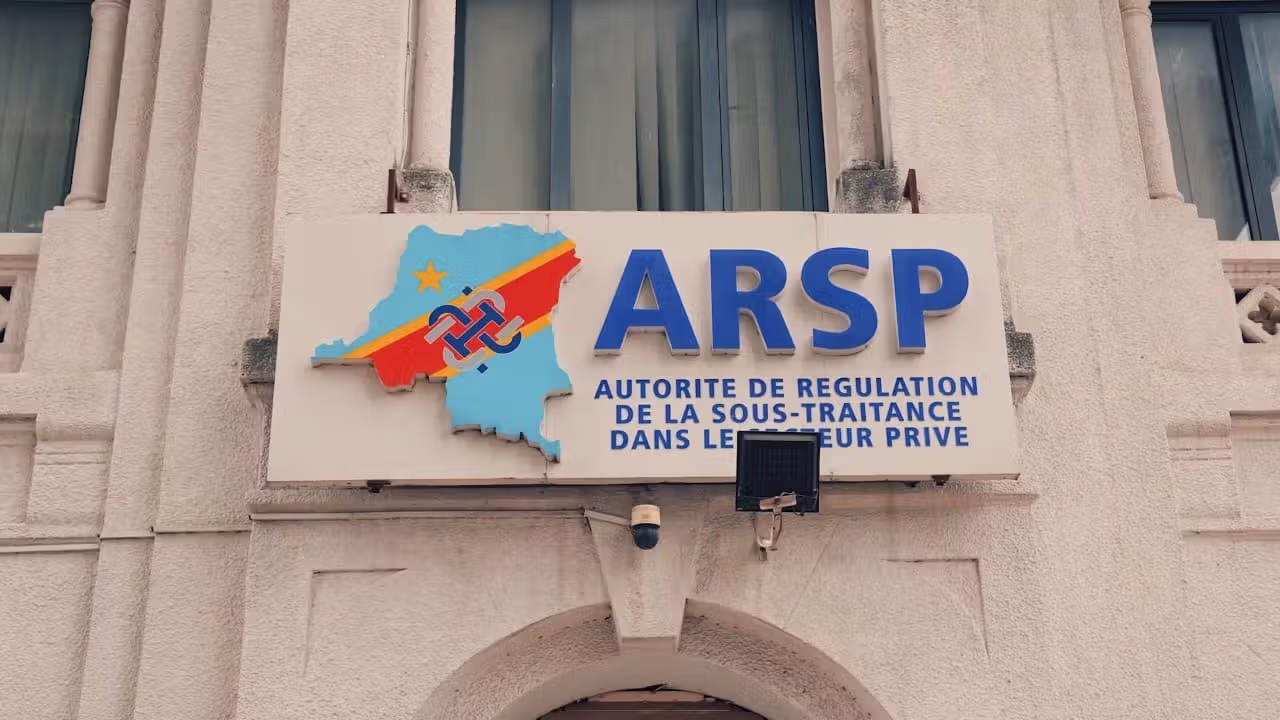
• Mandatory registration certificate: Issued by the Private Sector Subcontracting Regulatory Authority (ARSP), it requires the provision of a sworn declaration of the real owners, a copy of the shareholders' agreements and the tax clearance certificate.
• Proof of effective payment of dividends: Dividends owed to Congolese shareholders must imperatively be paid into bank accounts domiciled in the DRC.
• Payment regime: Payments related to subcontracting contracts must be made in the DRC. Direct payments to accounts located abroad for services performed on national territory are strictly prohibited.
• Mandatory start-up advance: The principal company can no longer compel a subcontractor to pre-finance an entire contract. An advance covering at least 30% of the contract amount must be paid before performance begins.
1. A strict redefinition of the Company with Congolese capital
To benefit from the subcontracting market, it is no longer enough to display a simple theoretical majority of shares held by nationals. The law now requires the combination of rigorous cumulative criteria:
• At least 51% of the capital held by natural or legal persons of Congolese nationality;
• Management and administrative bodies that are predominantly Congolese;
• Staff essentially made up of nationals;
• And above all, real effective control, demonstrable and materialised by the power of strategic orientation and financial decision-making.
2. Strengthened fight against front men and "artificial companies"
Artificial legal arrangements aimed at circumventing the law are expressly targeted. The use of front men or the creation of front companies devoid of real local economic substance are formally prohibited. Moreover, any arrangement aimed at draining the profits of a local company (via fictitious management fees, royalties or excessive interest paid to foreign entities) is now treated as fraud.
3. New administrative and financial obligations
• Mandatory registration certificate: Issued by the Private Sector Subcontracting Regulatory Authority (ARSP), it requires the provision of a sworn declaration of the real owners, a copy of the shareholders' agreements and the tax clearance certificate.
• Proof of effective payment of dividends: Dividends owed to Congolese shareholders must imperatively be paid into bank accounts domiciled in the DRC.
• Payment regime: Payments related to subcontracting contracts must be made in the DRC. Direct payments to accounts located abroad for services performed on national territory are strictly prohibited.
• Mandatory start-up advance: The principal company can no longer compel a subcontractor to pre-finance an entire contract. An advance covering at least 30% of the contract amount must be paid before performance begins.
III. Who is concerned and what are the risks in the event of non-compliance?
The economic actors targeted
This legislation concerns all sectors of the national economy (mining, energy, telecommunications, construction, transport, services, etc.), with the exception of derogations provided for by specific laws or regulated liberal professions (lawyers, chartered accountants, doctors, etc.).
Those directly impacted are:
• Principal companies (Contracting authorities): Which must ensure the eligibility of their subcontractors and reserve at least 40% of their subcontracted contracts for SMEs owned by young Congolese (18 to 35 years old).
• Subcontracting companies: Which must regularise their corporate structure and obtain their certificate from the ARSP.
• Principal companies (Contracting authorities): Which must ensure the eligibility of their subcontractors and reserve at least 40% of their subcontracted contracts for SMEs owned by young Congolese (18 to 35 years old).
• Subcontracting companies: Which must regularise their corporate structure and obtain their certificate from the ARSP.
A three-tier punitive regime
To guarantee the effectiveness of the law, the legislature has restructured the sanctions regime around three axes:
To guarantee the effectiveness of the law, the legislature has restructured the sanctions regime around three axes:
1. Administrative sanctions: Refusal or withdrawal of the registration certificate, cancellation of contracts or prohibition from bidding.
2. Financial sanctions: Heavy penalties in the event of payment outside national territory or non-compliance with invoicing and transparency rules.
3. Criminal sanctions: Prosecutions provided for against the perpetrators of front-man practices, undeclared work or shareholder fraud.
IV. How to prepare your company and protect yourself?
Compliance should not be seen as an obstacle, but as a strategic lever for sustainability. Here are the essential steps to implement:
1. Carry out a compliance audit of your shareholding and your contracts: Analyse your capital structure, your shareholders' agreements and the reality of the exercise of decision-making power to ensure compliance with the criterion of a company with Congolese capital.
2. Review your payment mechanisms and financial governance: Verify that all flows related to subcontracting pass through financial institutions approved in the DRC and that your contracts include the minimum 30% advance clause.
3. Update your files with the ARSP: Gather the required supporting documents (declarations of beneficial owners, tax clearance certificate, proof of dividend payments) to apply for or renew your registration certificate.
4. Adapt your procurement procedures: For contracting authorities, align your tenders with the requirements of the centralised digital platform and ensure compliance with the quotas reserved for SMEs.
The reform on local content in the DRC marks the transition from a logic of simple declaration to a rigorous requirement of proof and economic substance. Anticipating these rules is the best way to secure your investments and avoid interruptions of activity linked to audits or disputes.
Our law firm makes its expertise in business law and compliance available to business leaders, legal directors and compliance directors. We support you at every stage:
• Legal and organisational compliance diagnosis;
• Restructuring of shareholding and drafting of compliant shareholders' agreements;
• Audits of subcontracting contracts and assistance during procedures with the ARSP.
• Legal and organisational compliance diagnosis;
• Restructuring of shareholding and drafting of compliant shareholders' agreements;
• Audits of subcontracting contracts and assistance during procedures with the ARSP.
Disclaimer: This note is provided for general informational purposes only and does not constitute formal legal advice. If you require legal advice regarding the application of Law No. 26/017 to your specific corporate circumstances, please consult your legal advisor or contact our firm directly.